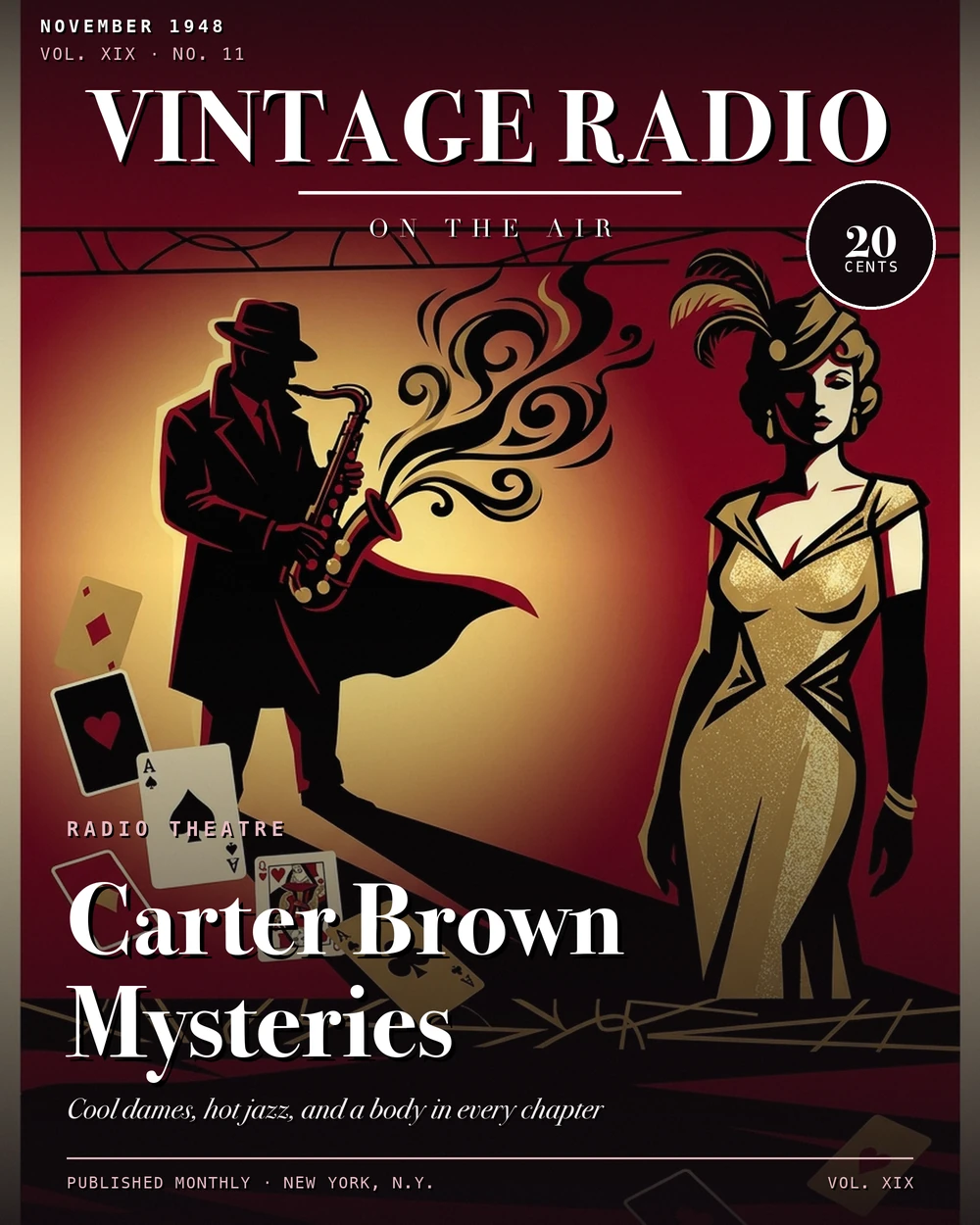
Carter Brown Mysteries
A Pen Name, Not a Detective
The first thing to understand about Carter Brown Mysteries is that Carter Brown was never a character on the show. The name belonged to Alan Geoffrey Yates — born in England on August 1, 1923, and later one of Australia's most prolific crime writers — who used "Carter Brown" as his pen name across an extraordinary publishing run. Between 1954 and 1984, Yates published somewhere between 215 and 270 Carter Brown novels and novellas, with reported worldwide sales in the tens of millions. When he died on May 5, 1985, he left behind one of the most substantial bodies of detective fiction ever produced by a single writer, and he was posthumously awarded the Ned Kelly Award for Lifelong Contribution to Australian Crime Writing in 1997.
The radio series drew directly on Yates's books, which were set in the United States and featured a rotating roster of recurring investigators rather than a single hero. The most prominent was Lieutenant Al Wheeler, a homicide detective in fictional Pine County, Los Angeles. Private investigators Rick Holman and Danny Boyd also appeared across the novels, and the radio adaptations carried that same structure — the detective changed from serial to serial rather than locking in one face for the whole run. The American settings were a publishing choice. As Yates himself noted, his publisher Horwitz Publications pushed for them because "Australians preferred them," and the radio versions followed suit.
How the Show Came Together
The series was produced by Grace Gibson Radio Productions, a Sydney-based company founded in 1944 by Grace Gibson, an American-born radio entrepreneur who built one of Australia's most ambitious independent radio production operations. The Carter Brown Mystery Theatre first broadcast in 1957, and the production encompassed two distinct series: Carter Brown Mysteries, which ran to 52 one-hour shows each structured as four connected 15-minute episodes, and the Carter Brown Mystery Theatre, a separate run of 26 half-hour programs. Together the two series produced over one hundred episodes during the 1950s.
The four-part serial structure was a deliberate departure from the format American detective shows typically used. Where most U.S. mystery programs ran as self-contained half-hour dramas, the Carter Brown format gave each story room to breathe across roughly an hour of broadcast time. Complex plots could develop at a more measured pace, supporting the kind of layered mysteries Yates's books were built around.
The production context mattered, too. According to the University of Queensland News, imported American cultural material was reportedly banned in Australia during this period, which pushed local producers toward making their own versions of American-style entertainment. The Carter Brown series sat squarely in that space — Australian-made, American-set, performed by Australian actors playing American characters with dialogue described as crisp and contemporary, pulled closely from Yates's own prose.
The Cast and the Sound
Grace Gibson assembled a roster of Australian talent that included some of the most recognizable names in the country's broadcasting and theatrical world: Ruth Cracknell, June Salter, Len Teale, Roger Climpson, John Meillon, Terry McDermott, and Gordon Chater all worked on the series. The cast brought considerable range to characters the source material described as having "a realistic, slightly seedy air to ensure readership identification among males" — detectives who weren't especially glamorous, surrounded by people who were often sharper or more dangerous than they appeared.
The dialogue was a genuine strength of the production. Yates had a natural ear for punchy, economical crime fiction prose, and because the adaptations drew so directly from the books, much of the talk came almost straight off the page. The series also gave itself an immediately recognizable sound through its theme music, built around a notably catchy Celtic beat — an unlikely choice for American-set noir that nonetheless stuck.
The detectives varied in personality and circumstance across the different serials, but the stories held together through the consistency of their plotting and tone. The noir approach was maintained throughout — morally complicated situations, women who complicated the cases in one direction or another, and a general atmosphere in which nothing was quite as simple as it first appeared.
The Stories in the Catalog
The 34 episodes held in the catalog reflect the serial structure the show was built around. "The Lady was Lethal" ran across three parts. "Crime for a King" extended to four. "Bella Donna was Poison" also ran four parts. Even the fragment listed as "High Sky Hoodo - Part 4" suggests a longer arc of which only the conclusion survives here. The multi-part format meant each story was genuinely constructed as a serial: cliffhangers, developing character threads, mysteries that accumulated detail before resolving.
The titles themselves carry the flavor of the Yates novels — a mix of femme fatale suggestion and hard-boiled economy. Women in the Carter Brown universe were frequently central to the cases rather than peripheral, whether as victims, suspects, or something more ambiguous. The series never softened that dimension of the source material, and the episodic titles signal as much before a single line of dialogue plays.
Reach and Recognition
Grace Gibson Productions didn't stop at Australia. The company syndicated its programs across New Zealand, South Africa, Hong Kong, Canada, and the British West Indies — giving the Carter Brown series a genuine international footprint at a time when Australian radio production was rarely heard beyond the continent. The American settings helped the material travel; the stories didn't require local knowledge to follow, which made them easier to place in markets where Australian cultural specificity would have been a barrier.
The lasting recognition for these productions came decades later. In 2012, the radio serials produced by Grace Gibson Radio Productions were inducted into the National Film and Sound Archive of Australia's National Registry of Recorded Sound, in recognition of their cultural, historical, and aesthetic significance. For a series that had largely faded from mainstream memory, it was a formal acknowledgment of what the productions had represented — a sustained, locally made alternative to imported American entertainment at a moment when Australian radio was finding its own voice.
The Carter Brown Mysteries occupy an unusual place in the history of radio mystery drama. They were Australian productions that sounded American, adapted from books written by an English-born author living in Australia under a pen name, syndicated internationally, and built around a novelist whose sales numbers rivaled far more celebrated genre writers. The 34 episodes in this collection represent a portion of a larger body of work that, in its time, reached listeners on multiple continents.